Last month, Mr. Li, the general manager of a hardware factory in Ningbo, decided to stop paying 8,000 yuan annually for his website server. This website, which he had paid 60,000 yuan to build five years ago, had always been his "online storefront." When asked why he was abandoning it, he opened the backend data and gave a bitter smile: an average of four visitors per day, two of whom were paid advertising bots, and one was a job seeker who stumbled upon the site by mistake. Real customers didn't exceed 100 throughout the year. Mr. Li's decision is not an isolated case. In the heart of the manufacturing industry in the Yangtze River Delta region, a silent wave of abandonment is underway. But listen carefully—what factories are abandoning is not the need for "online display," but rather the rotten shell of "static, unoperated" websites.
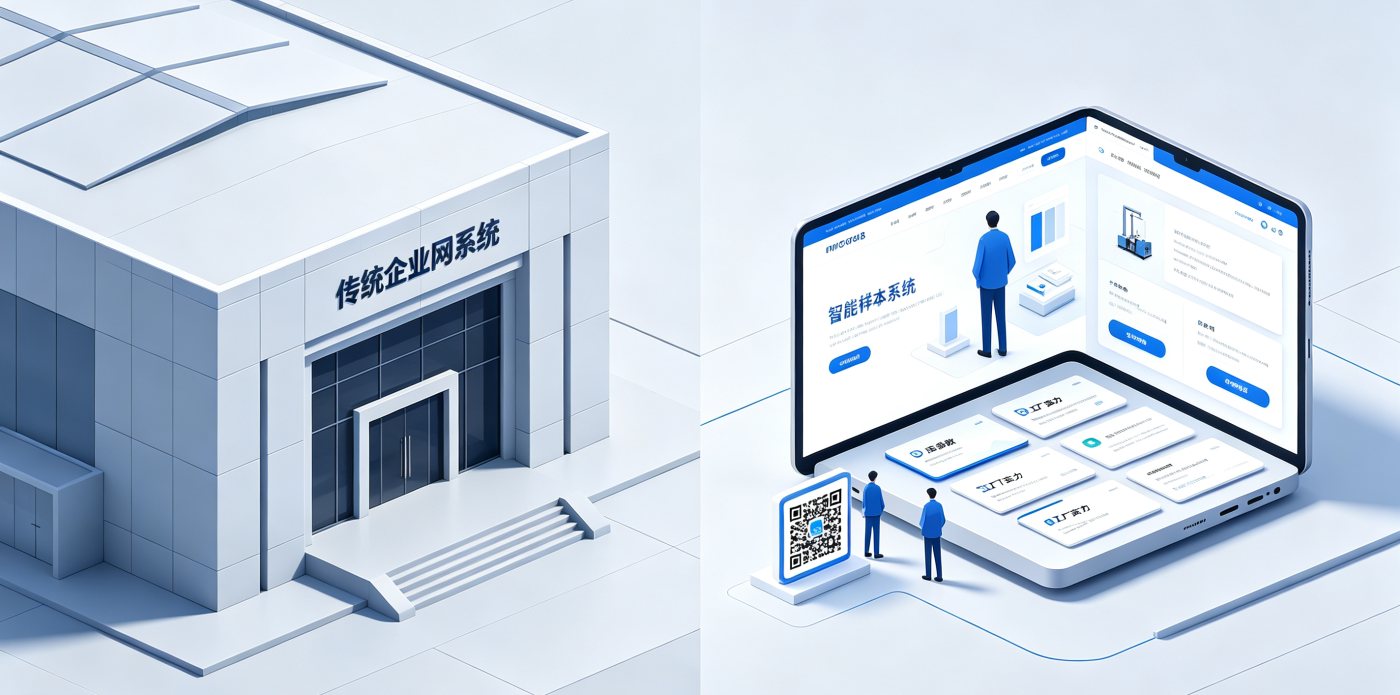
Is your website a showroom or a warehouse?
Claude Hopkins, the father of scientific advertising a century ago, once said something quite succinct: "Half of the money you spend on advertising is wasted, but you don't know which half." Today, the websites of factories in the Yangtze River Delta region are almost wasting the other half as well. Because you know exactly where it's being wasted. It's like a lonely exhibition hall 200 kilometers from the highway. You spend a fortune decorating it lavishly, displaying your best products (photos), and then wait. Waiting for a lost tourist to stumble in, glance at it, and leave. There are no guides, no interaction, no wayfinding, not even a single up-to-date product brochure.
Let's try to dissect this scenario using Clayton Christensen's "Caramel Pudding Theory." What exactly is the purpose of a customer "hiring" your official website?
The 1.0 era's task: To verify if you are a "legitimate factory." (A business license and a photo of the factory are sufficient.)
The 2.0 era's task: To gain a deep understanding of product parameters, conduct initial self-persuasion, and thus send a valuable inquiry.
Unfortunately, the vast majority of factory websites are still stuck in the 1.0 era. Essentially, it's just an "electronic yellow pages," lacking information beyond the company and contact details, and the page is lifeless. From the day it's created, it's the end point of an image-building project, not the starting point for generating orders. It's unupdated, devoid of content, like a specimen drained of its soul—beautiful, but dead.
What should a "living" online platform look like?
The real breakthrough lies not in "creating an even more beautiful official website," but in shifting from "static display" to "dynamic operation." The core carrier must shift from individual webpages to intelligent electronic samples that are disseminated, traceable, and evolving—a sample website that can be flipped through online.
Let's examine what qualitative change occurs when a traditional "dead website" transforms into a "living system" driven by intelligent electronic samples.

First, from "people searching for information" to "information finding people."
The fatal flaw of paper samples and traditional websites is waiting. Waiting for customers to come, waiting for customers to view. But an intelligent sample website—Enhe—hosted in the cloud and generating independent links, can be proactively pushed to WeChat, WhatsApp, and emails, like your 201st salesperson. It's not only seen, but it also provides feedback: Who is viewing it? On which page did they stay for how long? Which image did he repeatedly zoom in on? These behavioral data are the truly valuable "sales radar." This is no longer about wasting half your advertising budget, but rather, as Ogilvy said, using "concrete and real data" to guide every move you make.
Second, from "uniform messaging" to "personalized experiences."
If your customers are from Germany, Saudi Arabia, and Brazil, would you use the same Chinese sample booklet for them? Traditional "dead websites" can't switch languages, and salespeople can't provide real-time translation. But a smart electronic sample website allows customers to switch to their native language interface with a single click. It even has voice explanations and exploded 3D models. Essentially, this is doing one thing: using technology to achieve what Luo Zhenyu calls "cognitive folding," folding the complex capabilities of a factory into an interactive experience that can be understood in 3 minutes and will resonate with you.

Third, from "cost liabilities" to "digital assets."
Mr. Li spends 8,000 yuan annually to maintain a website with only single-digit visits—that's a liability. But if that 8,000 yuan is invested in an electronic sample that can be forwarded infinitely, where every click becomes data, and every share potentially generates targeted customers, then that becomes an asset. It aligns with Nassim Taleb's principle of "antifragility": the more it's shared, the more it spreads; the more it's accessed, the thicker the data becomes; the more it's iterated, the more precise it becomes. It generates continuous returns amidst volatility and uncertainty.
Conclusion: Don't let your factory be silenced in the digital age.
Manufacturing entrepreneurs in the Yangtze River Delta region are among the most pragmatic people on the planet. When they abandoned their official websites, it wasn't out of conservatism, but precisely because they keenly sensed the bottomless pit of sunk costs.
It's not that the internet abandoned manufacturing, but rather that the old-fashioned online format—"static, unmanned"—has been completely declared dead. What you need isn't to renovate a showroom that no one visits, but to build a "digital salesperson" that can speak, move, and understand data.
Ditch that "traditional website that doesn't provide substantial help to customers." Use a living, AI-powered intelligent sample network;
Sample Network · Enhe www.yangbenwang.com lets your factory and products come alive again on the mobile phones of buyers worldwide. Together, we become witnesses to the AI search era.